Community: owners, residents and service charges
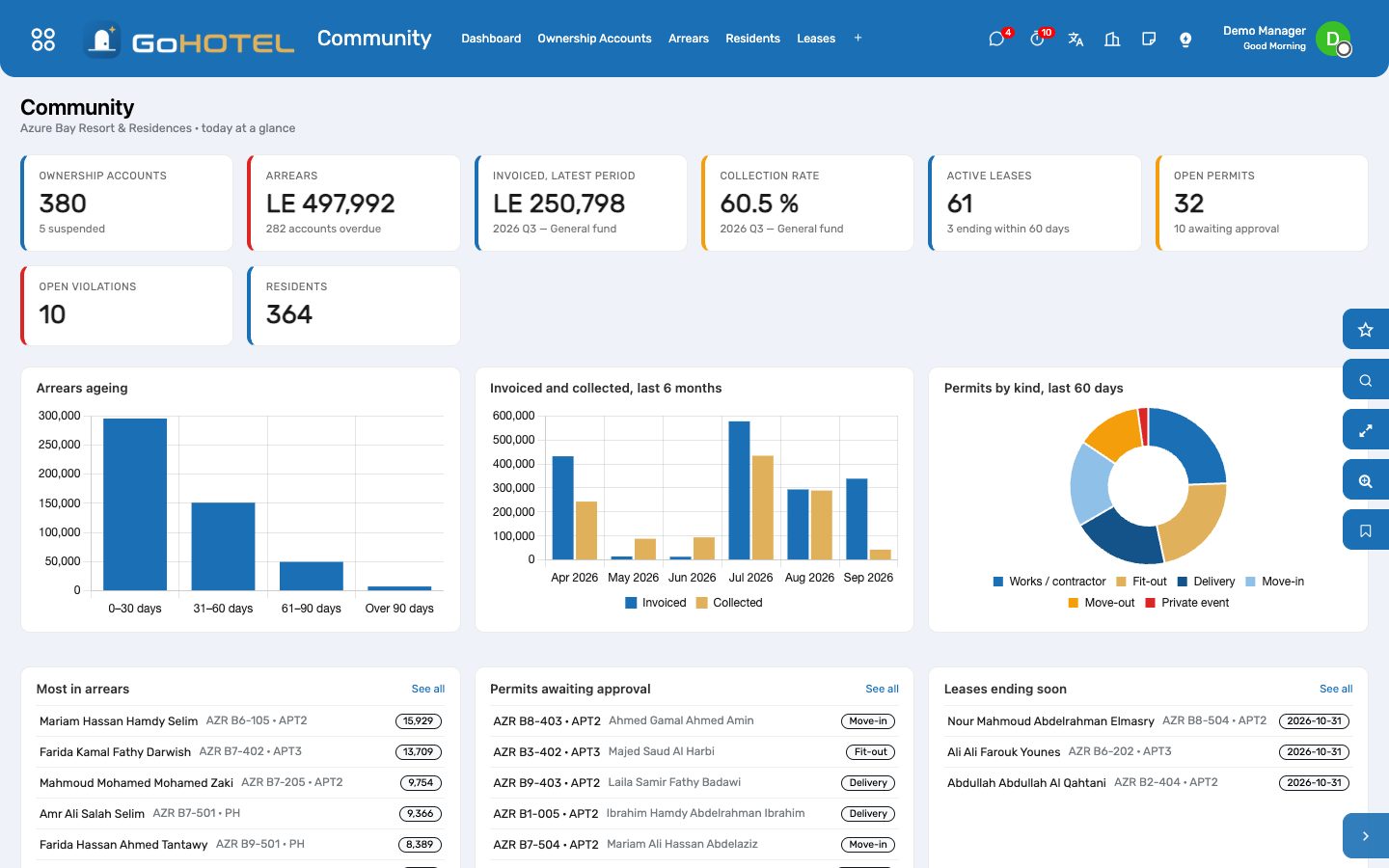
The compound or the village as a community: an ownership account per unit that owes the service charge, the people who live there, the leases and their rent, the budget by fund invoiced to every owner per period, the reminders and late fees that collect it, the permits at the gate, the fines, the notice board and the general assembly where owners vote by share.
Where:Community › Dashboard · Ownership Accounts · Arrears · Residents · Leases · Service Charges · Permits · Violations · Announcements · Assemblies · Configuration
Before you start
- Units flagged Owner-held with their owner, under Property › Units.
- A sales journal, a bank and a cash journal in Accounting.
- The community products (Community › Configuration › Products): one per fund, the rent, the late fee, the permit fee, the fine — with their taxes.
- Funds and the dunning ladder under Community › Configuration.
How to
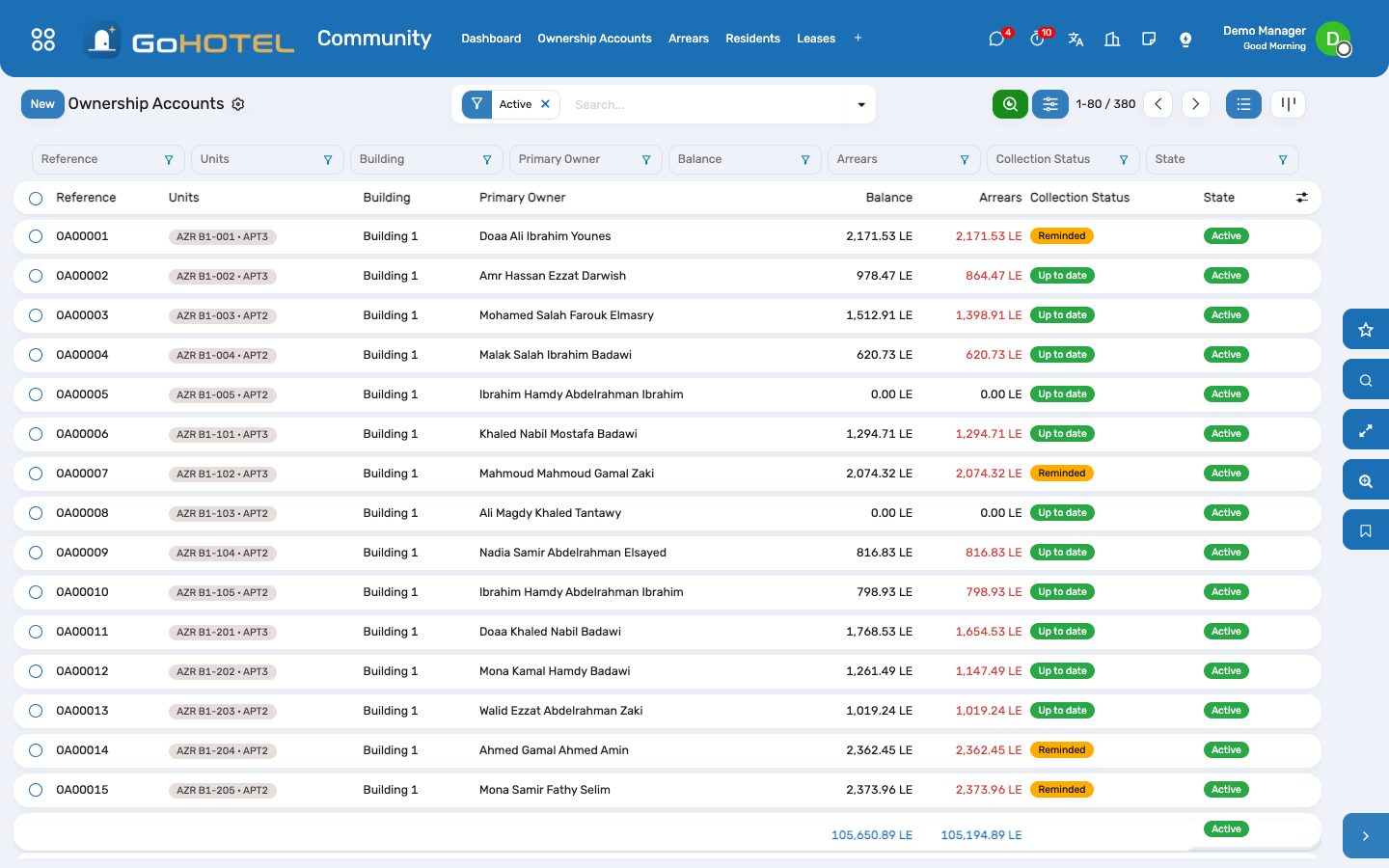
Open the ownership accounts
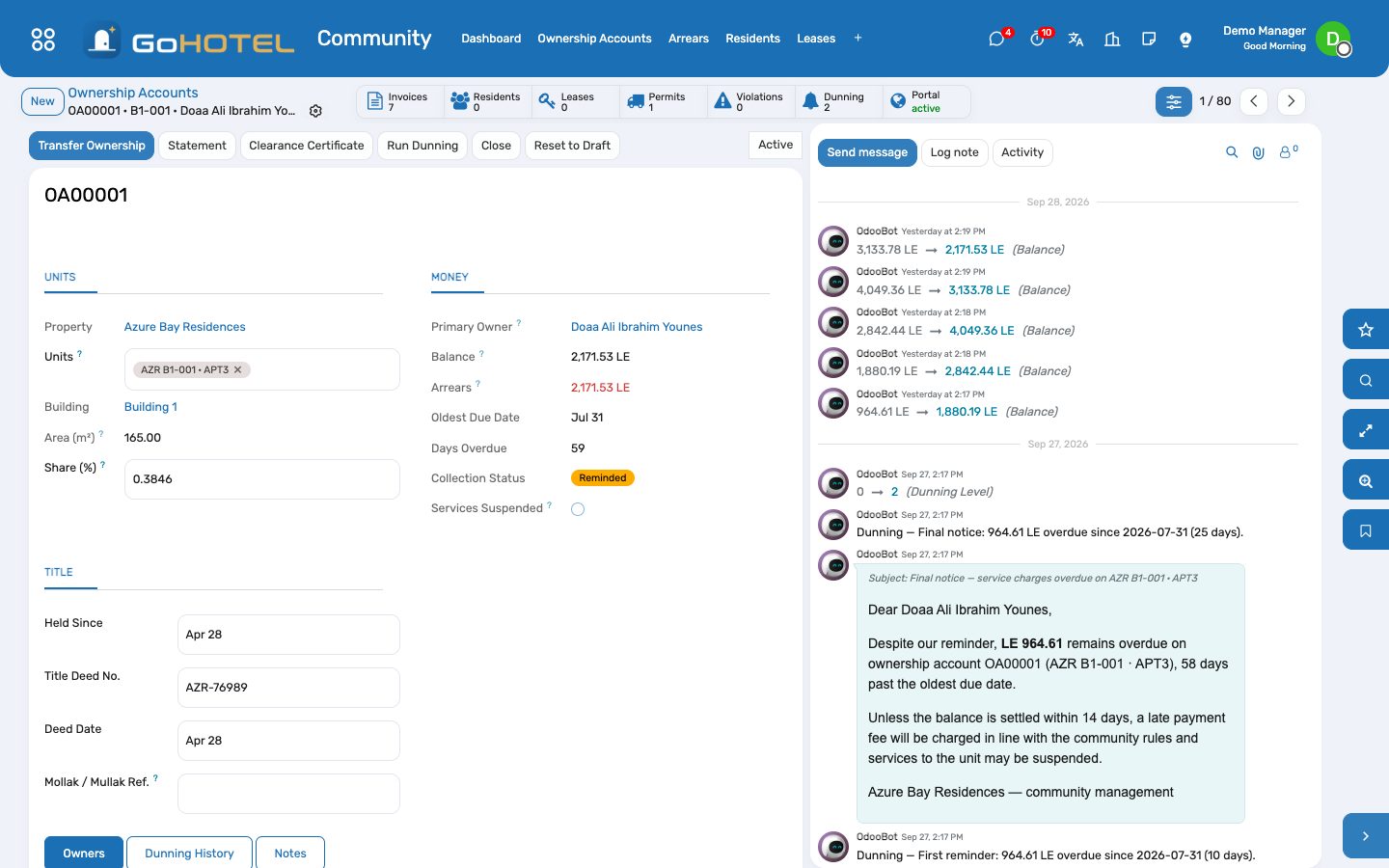
- Community › Ownership Accounts › New: the property, the unit (or the units one owner holds together), then the owners on the Owners tab with their shares and who is primary — the primary owner is the one invoiced.
- The share of the community fills itself from the area of the units; type over it when the register says otherwise. Add the title deed number and the Mollak / Mullak reference.
- Activate. The unit now shows this owner as its owner of record; every service charge, levy, late fee and fine to the owner is invoiced through the account and its balance and arrears read from Accounting.
Register the residents
- Community › Residents › Residents › New: the contact, the unit, the role (owner living in, tenant, family, domestic staff), the move-in date, the ID details, the vehicle plate and the access card.
- Group a family under Households with a head of household; the gate and the announcements read from here.
- Move Out closes the record with the date; the history stays on the unit.
Sign a lease and invoice the rent
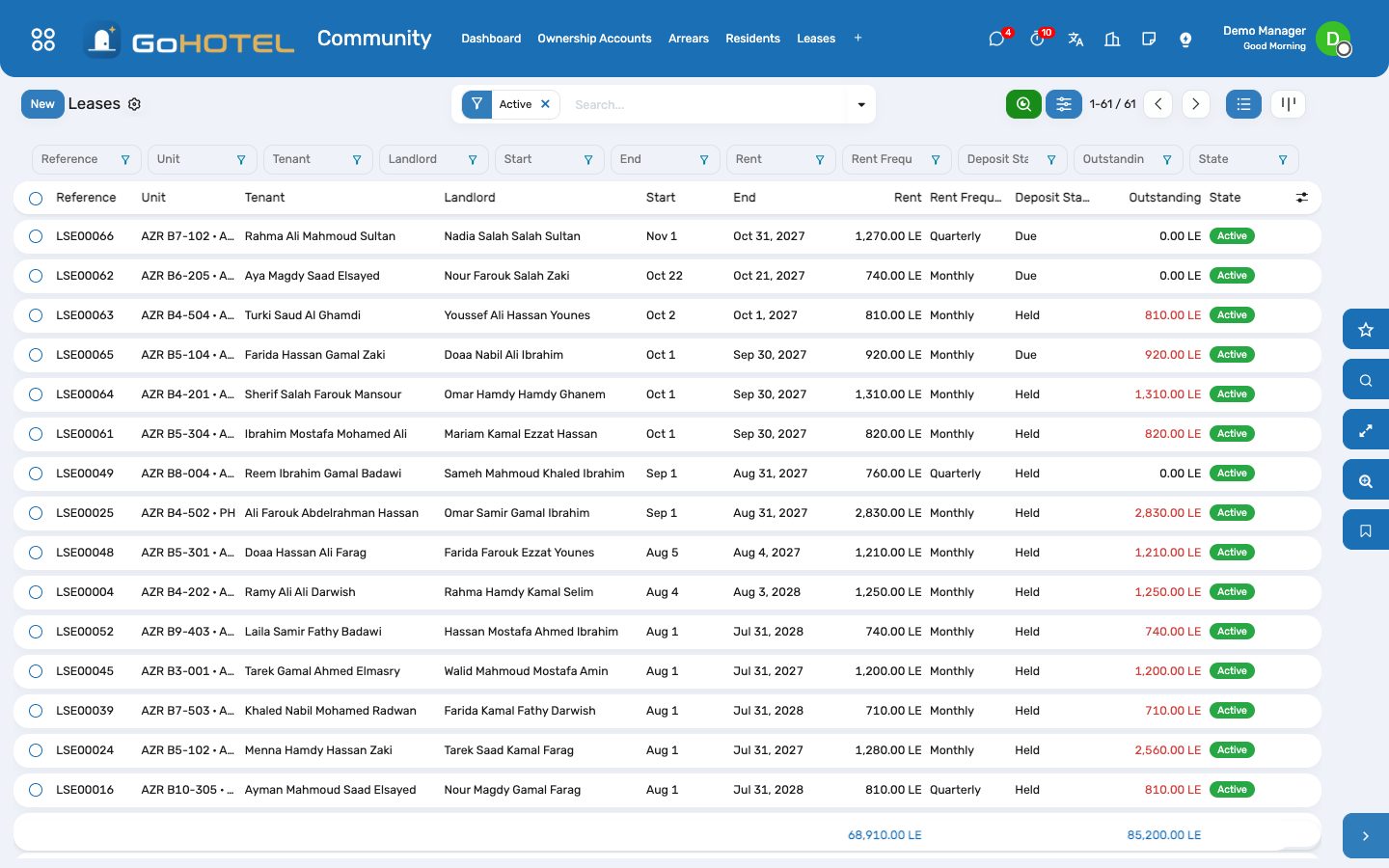
- Community › Leases › Leases › New: unit, tenant, start and end, the rent per period and its frequency, the deposit, the Ejar / Ejari / Tawtheeq reference.
- Generate Schedule turns the term into rent instalments (a last partial period is prorated); Activate opens the tenant as a resident.
- Receive Deposit posts a real receipt on the tenant's ledger. Record the move-in handover with the meter readings, keys and condition.
- Rent is invoiced by the daily scheduled action a week before each due date; Invoice Due Rents does it now. Rent Schedule lists every instalment with its invoice and what is still owed.
- A renewal activity is raised 60 days before the end; End Lease moves the residents out and frees the deposit for return or forfeit.
Budget the year by fund
- Community › Service Charges › Budgets › New: property, year, fund (general, reserve, special levy, master-community levy), the basis the total is split on — share %, area or per unit — and the lines by category.
- Approve it, quoting the assembly resolution or the Mollak / RERA approval. Create Quarterly Periods makes the four quarters, each due 30 days after it starts; a one-off levy is a single period with a share of the year of 1.
Invoice a period and follow the collection
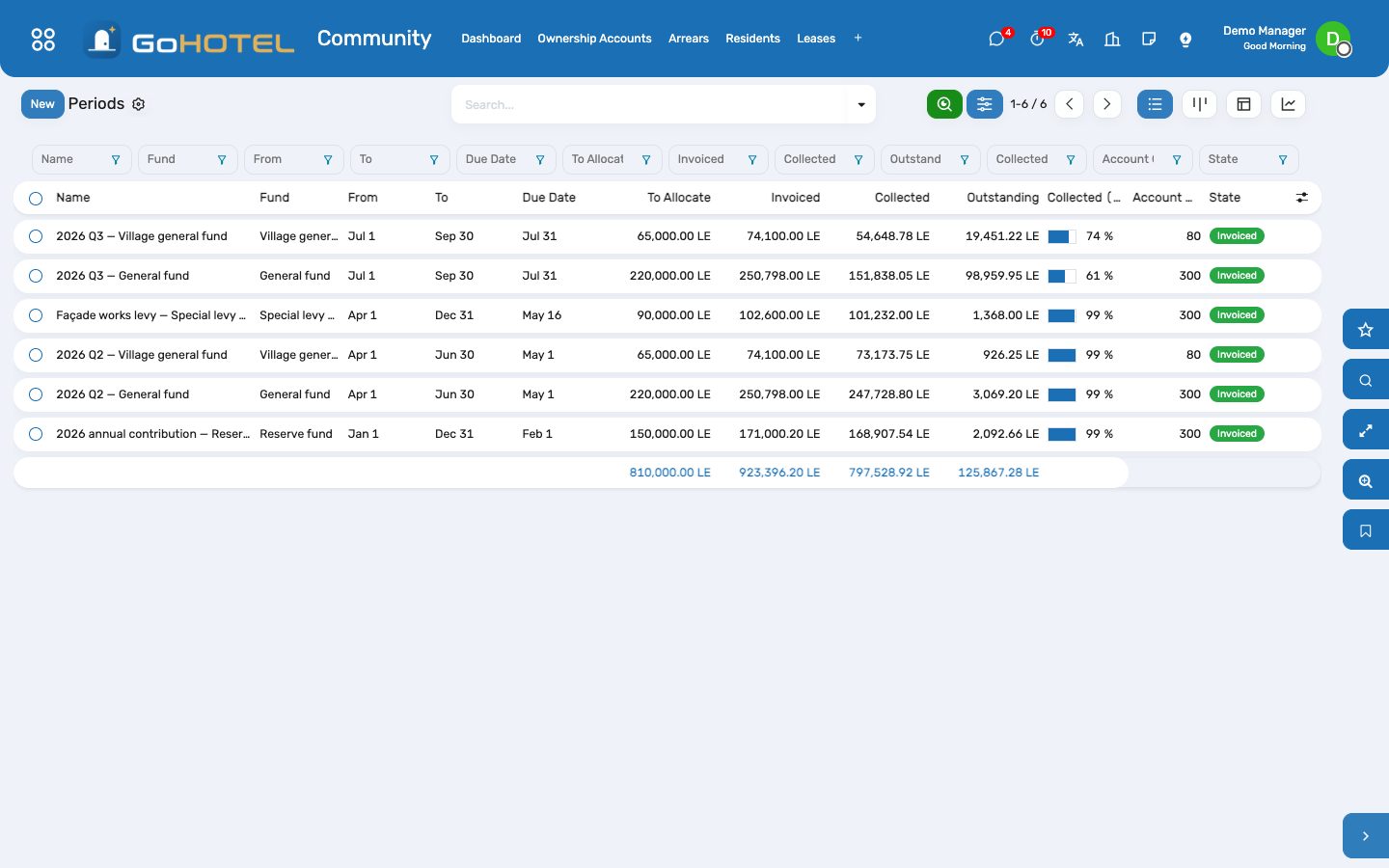
- Community › Service Charges › Periods: open the period and Invoice the Period. One customer invoice per active ownership account is posted, allocated by the basis, with the fund's product and its taxes, due on the period's due date.
- Payments are registered in Accounting as usual — bank, cash, card — and the period's collected amount, outstanding and collection rate follow.
- Invoices & Collections pivots every invoice by period, fund and building; Arrears lists the accounts behind, by collection status.
Let the dunning ladder run
- Community › Configuration › Dunning Ladder: the rungs and their days overdue — first reminder at 7, final notice at 21, late fee (2 % of the arrears, minimum 25) at 60, suspension of services at 120. Rungs without a property apply everywhere; a property's own rungs override them.
- The daily scheduled action climbs one rung per account per day as the oldest unpaid invoice ages: the reminder e-mails go to the primary owner, the late fee is a posted invoice on the account, the suspension flags the account so that permits are refused.
- Run Dunning on an account does the same by hand. When the arrears are settled the ladder resets and the log says so.
Transfer a unit to a new owner
- On the active account, Transfer Ownership: the date, the new owners and their shares, the new deed number.
- With a balance outstanding the transfer is refused unless Transfer despite the balance is ticked — the certificate then states the arrears carried over instead of a clearance.
- The old account turns Transferred with the clearance certificate number and prints it; a new active account opens on the same units and the unit shows the new owner.
Permits at the gate
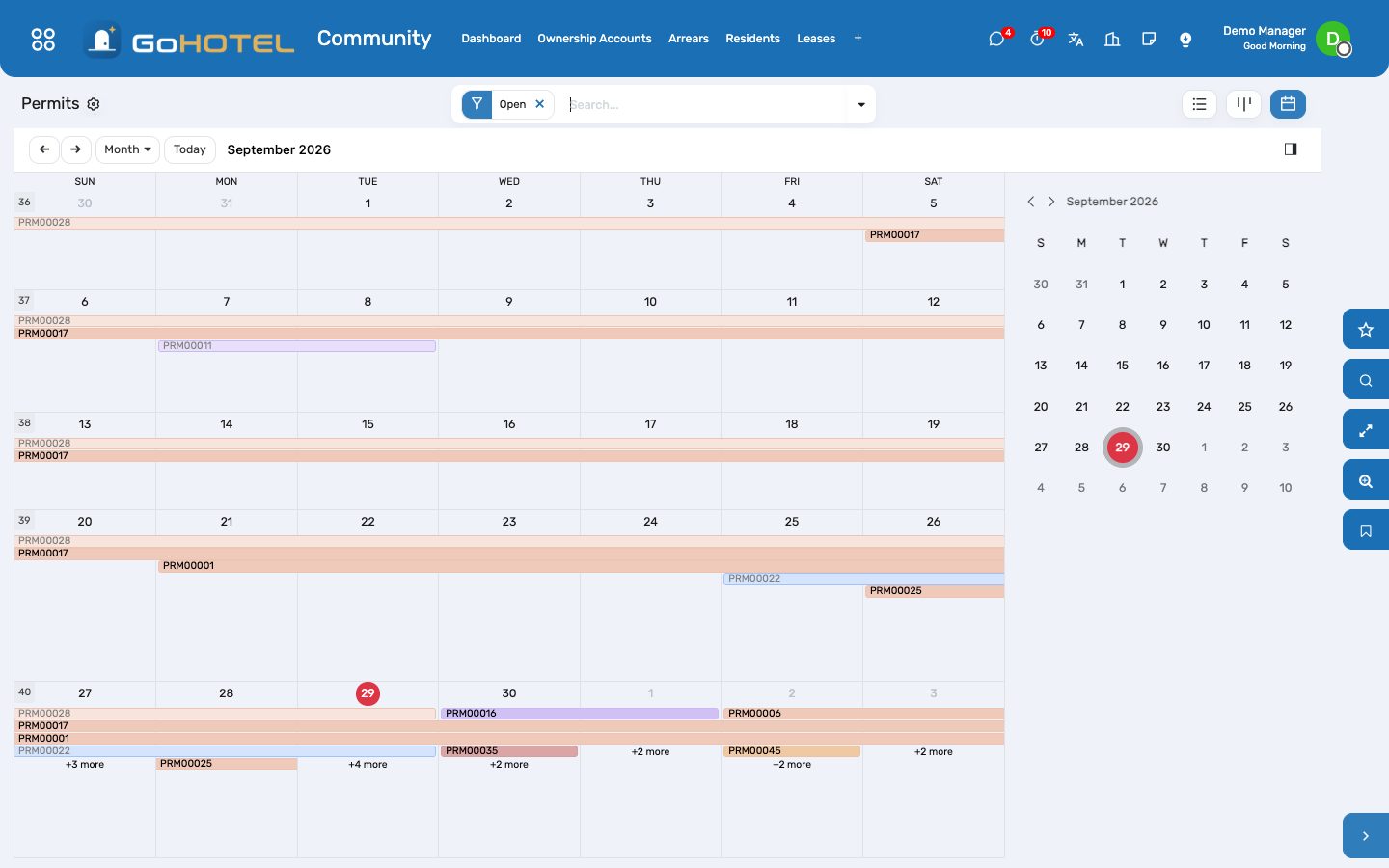
- Community › Permits › New: move-in, move-out, fit-out, works, delivery or event; the unit, the applicant, the contractor, the days and hours, the vehicle, the workers to expect and any instruction for the gate.
- Fit-outs and works carry a fee: approving the permit posts the fee invoice to the applicant. An account suspended for arrears cannot get a permit except a move-out.
- The calendar shows the week the gate will have; Start when they arrive, Close when they are done.
Violations, fines and appeals
- Community › Violations › New: the rule broken (Configuration › Community Rules carries the fine and the fine on repeat), the unit, the resident or owner, the date and the evidence.
- Notify sends the notice; Issue the Fine posts the fine invoice; an appeal is recorded and either dismissed (the unpaid fine is credited) or closed.
Announcements and the general assembly
- Community › Announcements › New: title, category, audience (owners, residents or both), the notice; Publish puts it on the board, Send by E-mail mails everyone in the audience.
- Community › Assemblies › New: date, place, quorum, the agenda with the majority each resolution needs. Convene publishes the notice with the agenda to the owners.
- Open the Meeting, then record the ballots — one per ownership account and item, weighted by the account's share; proxies are flagged. The result of each item and the quorum are computed as the ballots come in. Close the meeting with the minutes.
Questions the desk asks
An owner holds three apartments — three accounts or one?
Either. One account with three units is invoiced once per period for the sum of the three; three accounts give three invoices and three balances. Choose what the owners' register does.
Where do the payments go?
To Accounting, like every customer payment: Register Payment on the invoice, or reconcile the bank statement. The account's balance, the period's collection rate and the dunning ladder all read from the invoices.
Can the service charge carry VAT?
It carries whatever taxes the fund's product carries. Set them on the product under Configuration › Products; a rent or a fine with no taxes is a product with none.
The tenant's rent is not the owner's debt, is it?
No. Rent invoices go to the tenant and are tagged with the lease, never with the ownership account; the owner's balance holds only what the owner owes the community.
A suspended owner needs to move out.
A move-out permit is the one kind a suspended account can still get; everything else waits for the arrears to be settled, at which point the daily run resets the ladder.
See also: The property, its units and its fee rules Guests and accounts