The property, its units and its fee rules
Everything hangs off the property: buildings and floors, unit types with their occupancy and rack rate, units with their housekeeping and occupancy state, bookable spaces, departments with their cost centres, seasons, and the fee rules that turn a room rate into a guest's total.
Where:Property › Properties · Unit Types · Units · Spaces · Fee Rules · Configuration
Before you start
- The company's country and its chart of accounts (VAT taxes) in Accounting.
How to
Create the property
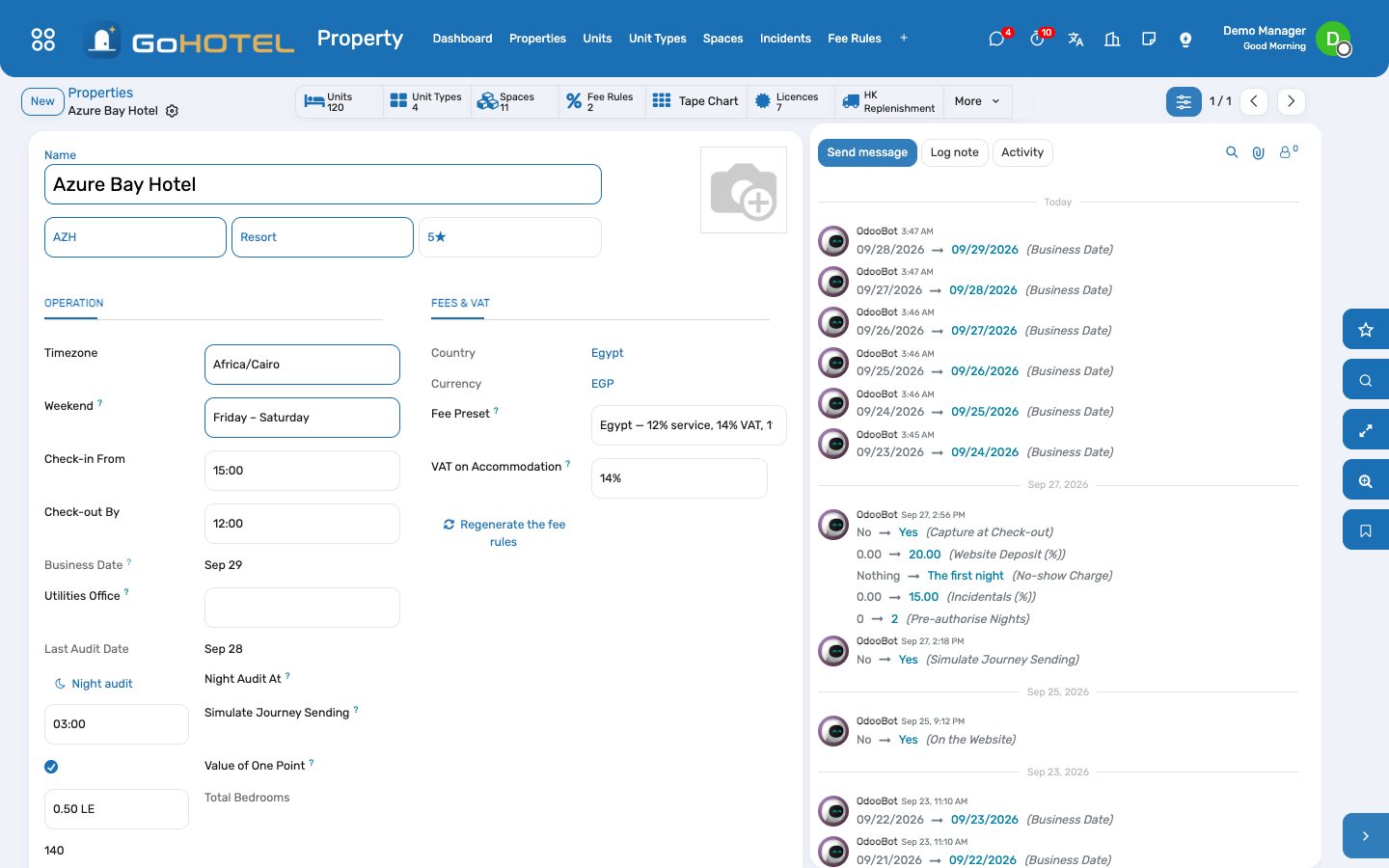
- Property › Properties › New: name, code (used in every document number), kind, star rating, timezone, weekend, check-in and check-out times, audit hour.
- Pick the fee preset for the country (Egypt: 12 % service charge inside VAT, 1 % city tax outside; Saudi Arabia: municipal fee; Dubai: service, municipality, Tourism Dirham; Abu Dhabi: service, tourism and municipality fees). The rules are generated; edit or add your own under Fee Rules.
- Check VAT on Accommodation — it is the tax put on room nights and on every fee inside the VAT base.
Unit types and units
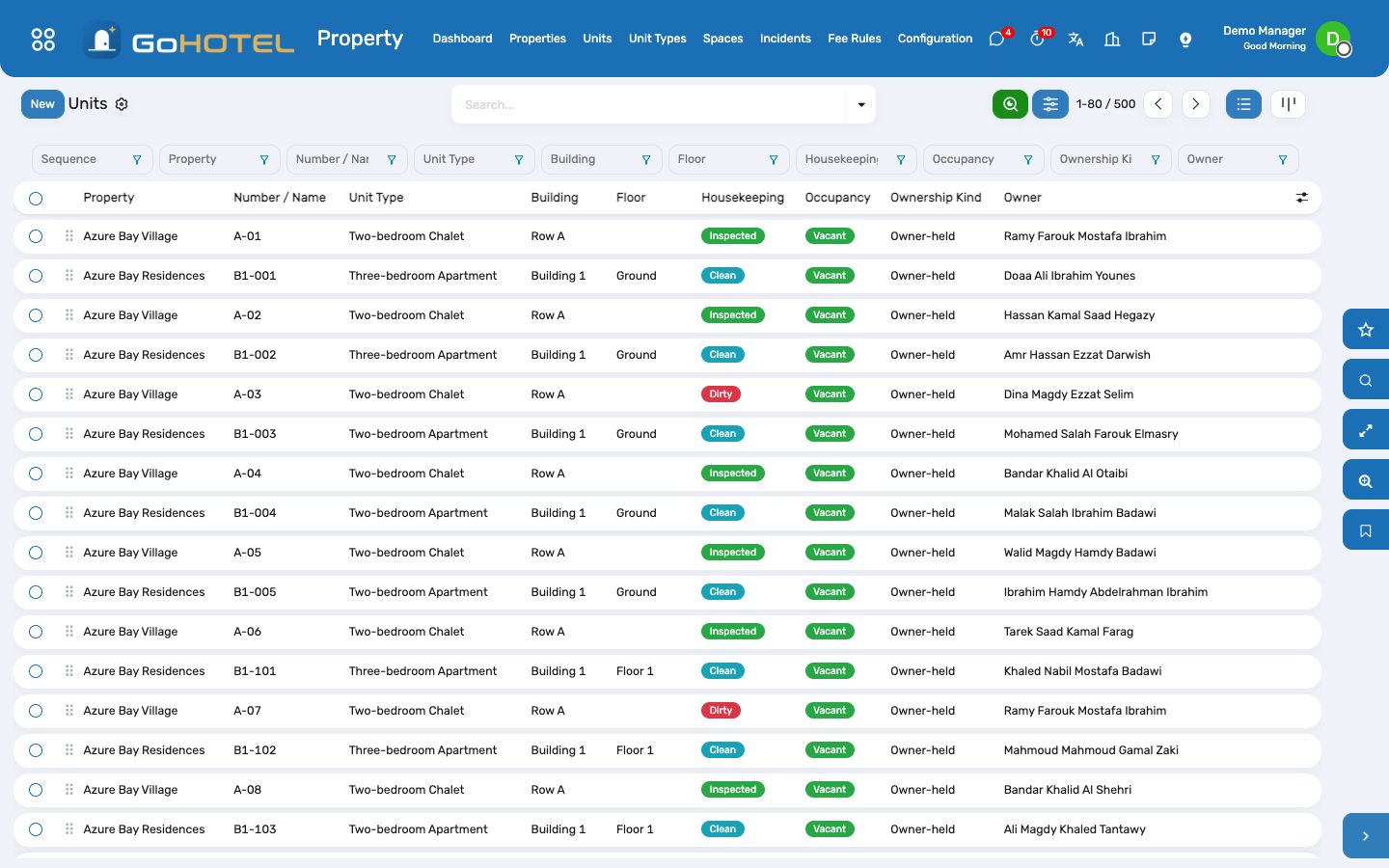
- Unit Types: code, kind (room, suite, chalet, villa, apartment, cabin, berth), base and maximum occupancy, extra beds, bedrooms, amenities, rack rate. A service product is created for the accommodation revenue.
- Units: number, type, building and floor, view, connecting, accessible; owner-held units carry their owner. Virtual units (house accounts) are never sold and never counted.
- The licensed-unit count on the Subscription screen is the number of active, non-virtual units.
Departments and cost centres
- Property › Configuration › Departments: Rooms, each outlet, Minibar, Spa, Events, Laundry, Telephone, Transport, Utilities, Community.
- Create cost centre gives each an analytic account; charges carry it to the invoice line, so revenue by department needs nothing more in Accounting.
Seasons
- Property › Configuration › Seasons: date ranges with a kind (low, shoulder, high, peak, Ramadan, Eid, Hajj) and a priority; a Hijri label prints beside the dates.
- Rates reference seasons; the calendar view shows the year.
Questions the desk asks
We run a hotel and a village in one company.
Two properties in one database, each with its own units, rates, business date and fee rules; one accounting.
A unit is out of order for a week.
Set it out of order with the dates and the reason (or let a maintenance request do it); availability skips it and the tape chart hatches it.
See also: Guests and accounts Rate plans, rates, restrictions and allotments